Source: http://www.durtydan.com/ddapp/handsignal.html
INTRODUCTION
Most teams have a very effective verbal communications system. They often times use codes to relay information to one another. However, there are times when, even though the opposing teams may not be aware of your codes, shouting the codes WILL make them aware that you are up to something. Sometimes, there are situations where you simply do not wish to to make any verbal sign at all.
That's where hand signals come it.
The key is not too have too many different hand signals (which makes them hard to remember) but still have enough to cover most of your codes. This system addresses both problems by using very easy to remember signals and variations. Also the signals are all ONE-HANDED as the most you'll ever have in the game is one free hand, unless your team routinely goes onto the field without markers.
These signals could also be used by teams who specialize in scenario games. Often times, as they will attest, verbal communication is not tactically sound.
Remember that these signals are limited, they can only be used when you have a direct line of sight to a fellow teammate. However they have the advantage that in most situations, only your team will be aware codes are being used. It is a lot easier for someone on the side lines to associate a verbal code with the subsequent actions of your team. If they don't see the hand signal, to them the player(s) in question simply acted on their own.
As an aside, you can even substitute your own hand forms the the Basic Signals. Instead of a thumbs up, you can show a fist with your small finger extended, etc.
REPLACING CODES
This system does not have to represent ALL your team codes (although it conceivably could). You could decide that only those codes most frequently used could have hand signals.
THE SYSTEM
The system is comprised of 6 Basic Signals, 2 Up/Down Variations (for each basic) and 4 Motion Modifiers (for each Basic and Variation).
You can then use each Basic Signal with no motion, add 2 Up/Down Variations and then add the four Motion Modifiers.
If you use the Basic Signals AND the Up/Down Variations AND the Motion Modifiers you'll have almost sixty different signals.
THE BASIC SIGNALS
THUMB
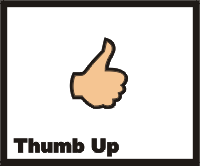
This is the basic thumbs-up gesture. This should not be used for the normal "okay" or "yes" as this is too easily figured out by observers.
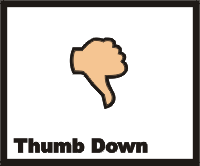
This is the basic thumbs-down gesture. This should not be used for the normal
"negative" or "no" as this is too easily figured out by observers.
POINT
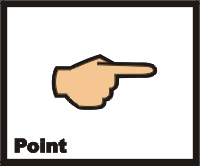
This is a natural pointing action.
SPREAD FINGERS
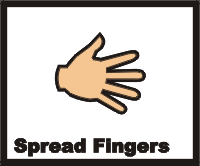
The hand is in the same position as the Thumb-Up but the hand is open and the fingers are spread. You are showing the palm (or back) of your hand to your teammate.
KNIFE HAND
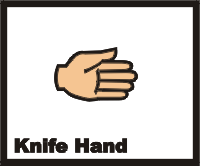
The hand is in the same position as the Thumb-Up and is held like you're going to do a "karate chop". Like the Spread Fingers you are showing the palm (or back) of your hand to your teammate.
FLAT HAND
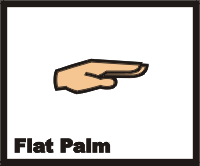
The hand is held in the same way as the Knife Hand, but the palm is horizontal, like you're patting the top of a dog's head. Unlike the Spread Fingers and the Knife Hand you are NOT showing the palm (or the back) of your hand to your teammate, you are showing the EDGE of your hand. (Either edge.)
NOTE: You maybe wondering why there isn't a similar sign with the palm up. It is not included as it is difficult to apply a Down Variation. After you read the Down Variations description hold you palm face up and try and do a Down Modifier on the signal and you'll see what I mean.
THE UP/DOWN VARIATIONS
For these you can either
present the signal with the hand in it's up or down position . . .
. . . or . . .
. . . first display the Basic Signal and then move the hand up or down.
UP
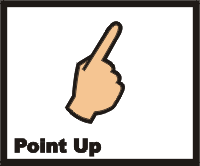
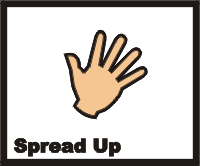
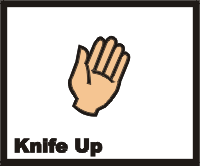
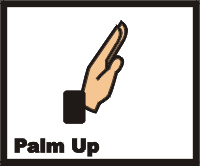 As you can see, they all are a Basic Signal pointing up. All the Basic Signals
are modified up by moving the arm. You will note that the Flat Hand is bent
at the wrist, this is because it's easier to do that way. (Also if you bend
at the wrists, the signal won't end up looking like a Nazi salute.)
As you can see, they all are a Basic Signal pointing up. All the Basic Signals
are modified up by moving the arm. You will note that the Flat Hand is bent
at the wrist, this is because it's easier to do that way. (Also if you bend
at the wrists, the signal won't end up looking like a Nazi salute.)
DOWN
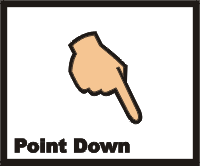
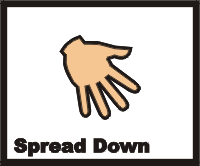
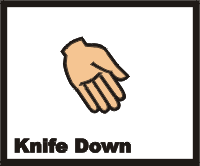
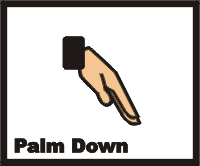 As you can see, they all are a Basic Signal pointing down. All the Basic Signals
are modified up by moving the arm. Again, you will note that the Flat Hand
is bent at the wrist, this is because it's easier to do that way.
As you can see, they all are a Basic Signal pointing down. All the Basic Signals
are modified up by moving the arm. Again, you will note that the Flat Hand
is bent at the wrist, this is because it's easier to do that way.
THE MOTION MODIFIERS
These modifiers can be applied to all the above Basic Signals and Up/Down Modifiers. For the sake of brevity, I have only illustrated one type of Basic Signal for each motion.
UP AND DOWN MOTION
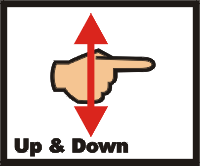
It's as easy as that, the signal is moved up and down.
BACK AND FORTH MOTION
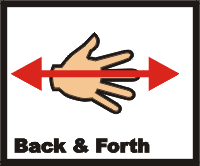
This motion is perpendicular (at a 90 degree angle) to the Up and Down Motion.
HORIZONTAL CIRCLE
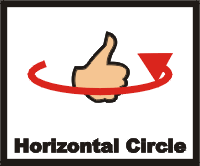
This is a circular motion parallel to the ground/floor. It doesn't really matter if it's clockwise or counterclockwise.
VERTICAL CIRCLE
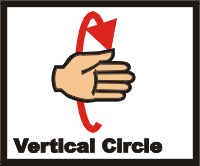
This is a circular motion perpendicular (at a 90 degree angle) to the ground/floor. It doesn't really matter if it's clockwise or counterclockwise.
CONCLUSION
While my system may seem confusing at first glance, if you ponder on it for a while (and actually do some of the SIgnals, Variations and Modifiers, you'll see that it is a surprisingly simple system.